A lot of creators assume affiliate links are something you deal with later.
Later means:
- once you have a manager
- once brands reach out
- once your audience is “big enough”
That assumption is why so many creators miss out early.
The reality is much simpler:
You don’t need a manager to use affiliate links.
You don’t need permission.
And you don’t need to change how you create content.
You just need to understand how the system works.
First, reset the expectation
Affiliate links aren’t a milestone you unlock.
They’re not a reward for growth.
They’re not a badge of legitimacy.
They’re infrastructure.
If you already:
- recommend products you use
- share tools that help you
- answer questions about what you run or wear or use
…you’re already doing the hard part.
Affiliate links just make sure you’re credited when that recommendation turns into action.
Where affiliate links actually come from
This part trips people up because it sounds more complicated than it is.
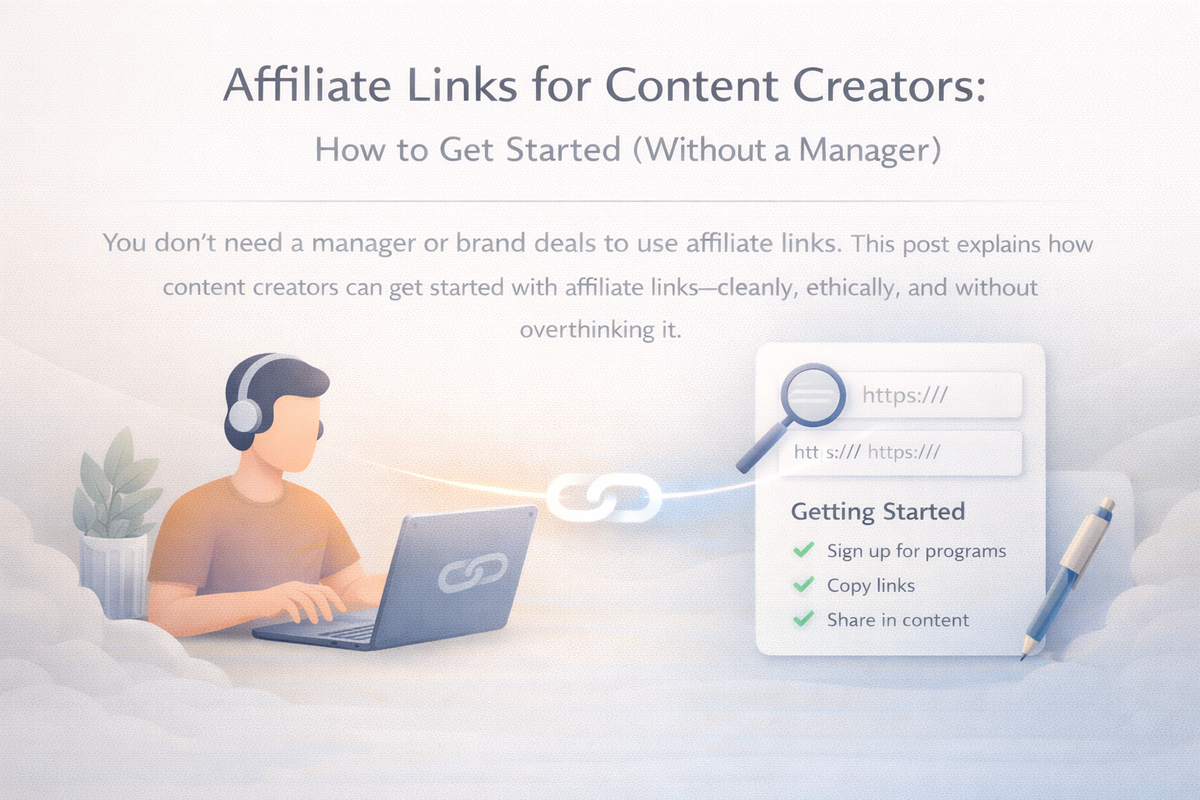
Affiliate links usually come from one of three places:
1. Brand-run affiliate programs
Many brands already run their own programs.
You apply directly, get approved, and receive:
- a unique referral link
- sometimes a discount code
- a dashboard for tracking performance
You don’t need a relationship with the brand.
You don’t need a pitch deck.
You don’t need a manager.
2. Affiliate networks
Some brands use networks to manage attribution.
These act as intermediaries that:
- host multiple brand programs
- generate links
- handle tracking and payouts
For creators, this often means:
- faster setup
- more programs in one place
- less back-and-forth
3. Direct brand outreach (later, not now)
This is what people usually think of first.
Emailing brands.
Negotiating terms.
Asking for custom links or codes.
That comes later.
If you start here, you’re doing things backward.
What you actually need to get started
You only need three things:
1. A place to send people
This could be:
- a link-in-bio (for now)
- a YouTube description
- a pinned resource page
It doesn’t need to be perfect.
It just needs to exist.
2. One or two real recommendations
Not a list of ten.
Not a “resources page” with everything you’ve ever used.
Start with:
- the product people already ask you about
- the tool you mention naturally
- the thing you’d recommend even without a link
That’s it.
3. Consistency
This matters more than volume.
If you mention a product:
- the link should exist
- it should work
- it should be easy to find later
Most creators fail here, not because they don’t try — but because there’s no system to support it.
What not to do early on
These mistakes are common, and they slow people down:
- Waiting for brands to reach out
- Signing up for dozens of programs at once
- Posting links everywhere “just to test”
- Forcing affiliate links into unrelated content
None of that is required.
Affiliate links work best when they’re boring, predictable, and available — not aggressively promoted.
Why starting early matters (even if you’re small)
Affiliate links don’t require scale.
They compound quietly.
Starting early means:
- your recommendations are already attributed
- you build habits before things get complex
- you don’t have to retrofit systems later
The creators who struggle most with affiliate links are often the ones who waited too long and then tried to bolt them on after the fact.
The real goal isn’t setup — it’s sustainability
Getting an affiliate link is easy.
Keeping it:
- organized
- up to date
- visible when it matters
…is the hard part.
That’s why so many creators technically “have” affiliate links, but still earn very little from them.
The system around the link matters more than the link itself.
Where this leads back to Aardvark
This is exactly the progression most creators follow:
- They start recommending things naturally
- They add affiliate links later
- The links get scattered
- Visibility drops
- Reposting increases
- Friction builds
Aardvark exists to remove that friction — not by changing how creators create, but by fixing how attribution works once someone is ready to buy.
You don’t need to think about that on day one.
But starting clean makes everything easier when you get there.
Key takeaways
- You don’t need a manager to start using affiliate links.
- Affiliate links aren’t a tactic — they’re attribution.
- Start with one or two real recommendations.
- Consistency beats volume.
- The system around the link matters more than the link itself.